TOOL · 3D
Human Atlas
An open-source interactive 3D anatomy explorer that takes the BodyParts3D adult male reference apart into 2,234 individually selectable meshes across 15 anatomical systems and 3,432 named concepts. Built with React, Three.js and shadcn/ui, generated by GPT-6 Astra and shared open by ashe (@ashebytes) as a follow-up to his earlier exploded-Tesla web experiment.
Here's the thing.
@xiaoerzhan (小耳, Xiaoer Jane) opened her post the way she usually does, with a small gasp. GPT Astra is too strong. She only meant to take her camera apart, and look at what happened, it pulled the human skeleton apart too.
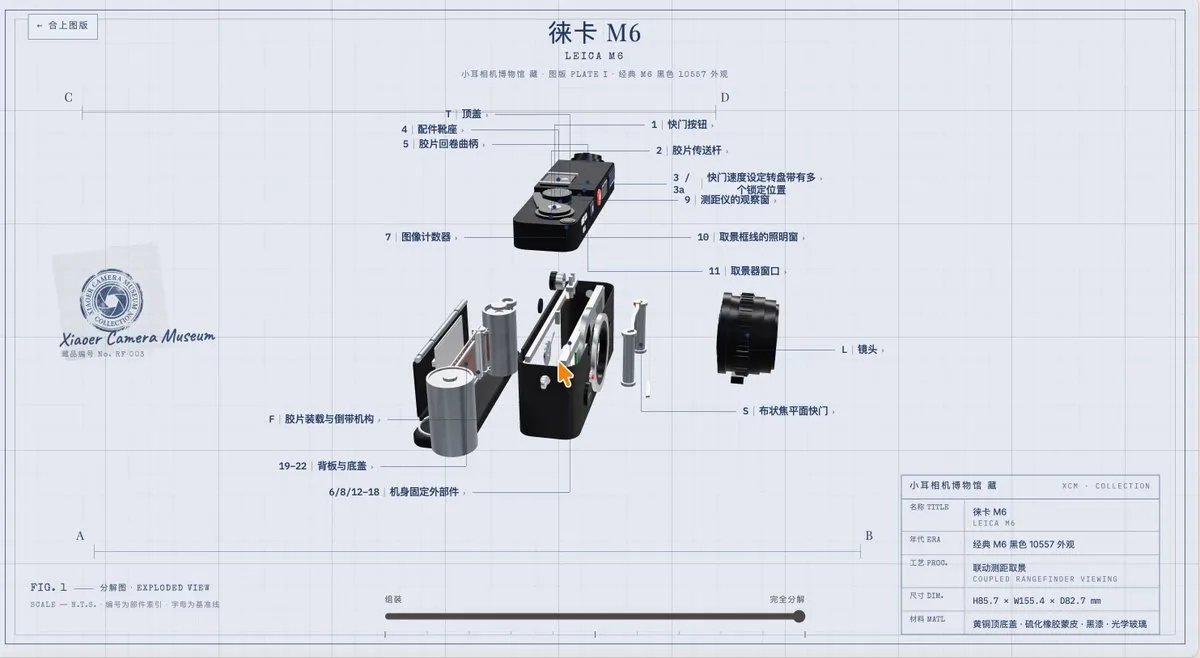
She has been working on a Leica M6 exploded-view piece, a blue-and-white technical schematic that flags 10,557 individual components on the camera. A labor of love. Then she saw what @ashebytes had just shipped with the same model, and her takeaway is the line of the post.
The model can do it. The problem was never capability. The problem was that we weren't asking hard enough.
The video with the post is the Leica M6 schematic itself, scrolling through the part annotations on a blueprint-style background, a fitting cover for what she spent tokens on.
The thing that broke her focus is the project she quotes, from @ashebytes (Ashe). Since you guys loved the exploding Tesla, I used GPT-6 Astra to create a 3D website that pulls apart the male anatomy into 2,234 modeled pieces. We are in a renaissance of learning.
That post is a follow-up to Ashe's earlier exploded-Tesla web experiment, and it landed hard. 36,278 likes, 3,043 retweets and 2.85M views. The site is live at human-atlas-seven.vercel.app and the code is open at github.com/ashemag/human-atlas.
What the site actually is, from the README. An interactive 3D anatomy explorer built with React, Three.js and shadcn/ui. It takes the BodyParts3D adult male reference apart into 2,234 individually selectable meshes, lays out 15 anatomical systems, and indexes 3,432 named concepts.
The interface handles the usual orbit-zoom-select loop on the body itself, plus toggling individual systems or pulling up skeleton and organ presets. It can move between an assembled anatomy view and a spaced inventory of every visible piece. There's a search field over anatomical names and source identifiers, and an isolation mode that pulls a structure off and reads its details into a side panel. Compact controls and a tighter detail panel are wired in for mobile.
Running it locally needs Node.js 22.13 or newer. No API keys, no accounts. npm ci, npm run dev, open localhost:3016. npm run build produces a static site in dist/.
On the data side. The viewer uses BodyParts3D 4.0, the adult male reference anatomy, licensed CC BY 4.0. It does not cover every human structure or variation, and individual source meshes are distinct from named concepts, which can group multiple meshes. Geometry is simplified for browser performance while still keeping every source mesh. The packaged model is 2,288,268 triangles and downloads around 33 MB of compressed geometry.
Worth flagging. The README is explicit. This is an educational explorer, not a diagnostic or surgical tool.
How it actually runs at that scale. Geometry is merged into batches. Per-structure GPU textures drive translation, visibility and selection, while component geometry supports accurate picking. Exploded layouts pack only the visible pieces. Rendering updates when the scene changes; orbit controls stay responsive even without thousands of separate draw calls. An optional WebMCP layer exposes anatomy search and inspection in compatible browsers, the visible interface works without it.
Validation. npm run check, node scripts/validate-atlas.mjs, node scripts/validate-interactions.mjs, then a build. The scripts cover mesh buffers, names and concept membership, non-overlapping exploded layouts at desktop and mobile aspect ratios, search and inspection contracts, and tap-versus-drag handling. Browser interaction checks have exercised selection, system controls, search, isolation, rotation, and three layouts, 390×844, 320×568, 844×390. Phone controls stay clear of the exploded inventory, and isolated structures fit the space above or beside the detail panel. Physical-device performance and real multitouch hardware haven't been tested.
Xiaoer's parting line lands the post. Her Leica M6 took forever, she doesn't even know how many tokens. The hard thing is now a one-line ask. If you can't crack something, put it aside. The model will get there soon enough.
At the time of writing, the post sits at 14 likes, 3 retweets, 15 bookmarks and 2,539 views. Original thread here, x.com/xiaoerzhan/status/2096431604054839309