SKILL · Image Generation
Nuyoah Portrait Prompt Skill
An open-source Chinese portrait-photography skill that reads a set of reference images, extracts their shared visual DNA, and rewrites makeup, wardrobe, scene, lens, pose and lighting as prompts you can still edit.
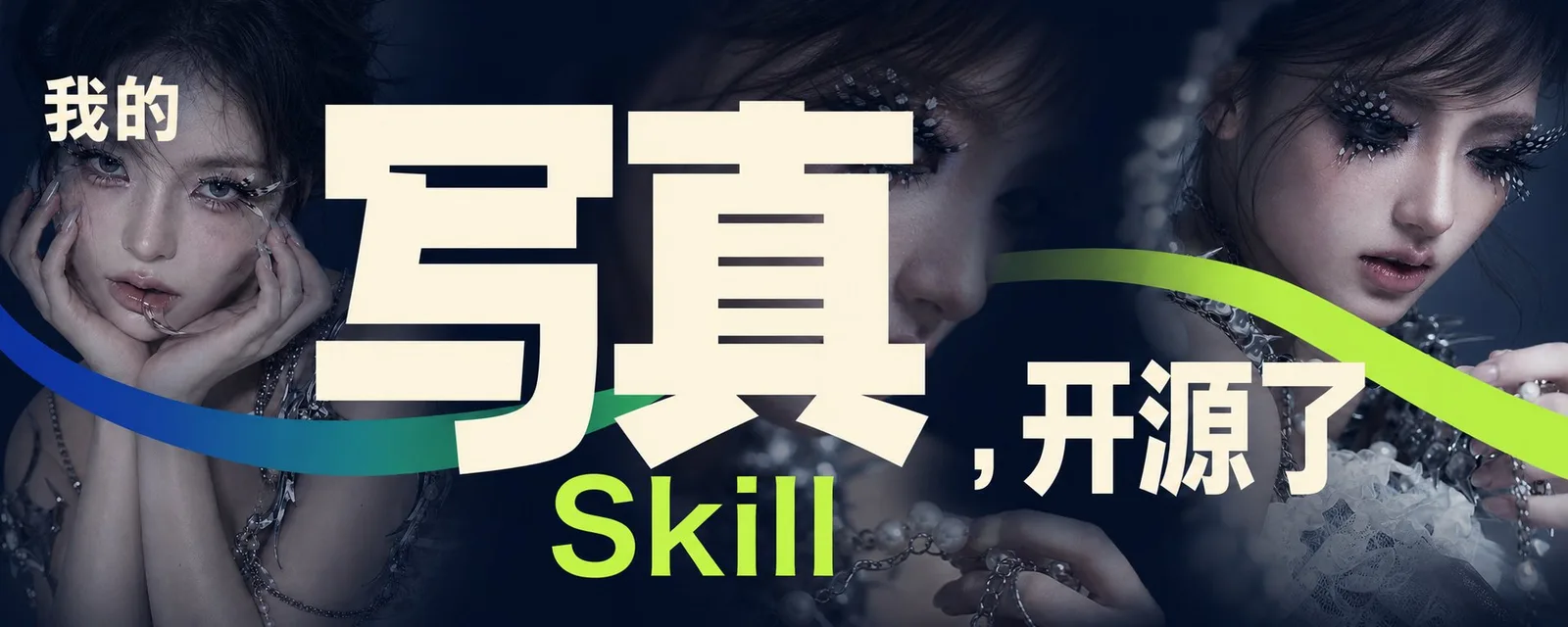
Saw an X Article from 南鸢 nuyoah (@nanyuan0412) titled, plainly, My portrait skill is open source.
The framing of the piece is what makes it worth reading. She is not shipping a prompt pack, and she opens by ruling that out: it is not a bundle of hard-coded prompts, and it is not just a tool for reverse-engineering one image.
What it actually takes is a single portrait, or a whole set of references. It looks for the visual DNA those images share, then writes makeup, wardrobe, scene, camera, pose and lighting out as a Chinese prompt you can keep editing.
What a series means here
Two results are shown to make the point. One from a short-keyword draw on the web version, one a same-series variant generated inside Codex.
They are not the same picture with a different pose. The pose changed. The camera distance changed. The composition and the foreground changed.
What stayed is the part that matters: cold silver tonality, the alien butterfly-wing eye makeup, the metal spike accessories, the cold white studio texture.
She calls that a series — keeping the same aesthetic world without cloning the same frame.
Editing control, not pixels
The part she uses most is the editing, and she is careful about what editing means here. It is not painting on the pixels. It is editing who holds control over what.
The examples are precise enough to be useful:
- Keep only the facial identity — replace makeup, hair, wardrobe and scene entirely.
- Keep the styling — redesign lens, action, composition and gaze.
- Fix the overall look and imaging method — let each frame carry different on-set light and skin reflection.
- Compress a long prompt into six to eight lines of short keywords, the kind the web version's draw works with.
- Plan P01 to P08 series masters first, then assign a different visual task to each frame.
If the skill is already loaded, the shortest instruction is to name what must stay — the same person, the same styling, the same garment — and let it handle the rest.
Her thesis, stated once and left alone: a prompt should not be an answer you can only copy. It should be a shooting plan you can take apart and put back together.
The limits are stated up front
The article is unusually honest about what it will not do, which is why the rest of it is easier to trust.
The skill handles looking, deconstructing and writing prompts. It is not an image generator. If the conversation has no generation capability, you get the prompt and a note that nothing was generated.
Reference sets work best when they come from one visual system. Throw in several images you happen to like with completely different makeup, photography and scenes, and the shared DNA gets diluted.
Complex lighting and heavy retouching are not promised at one-to-one fidelity. Studio portraits are more stable right now. The traditional Chinese costume direction is still under testing.
There is also a specific fix buried in the piece about close-up direct flash. Real skin texture is not a fully matte face, and glossy lips should not turn the whole face oily. The skill separates skin texture, T-zone highlight, cheek reflection and where the flash actually lands, and treats them as four different things.
The reshoot mode in the repo
The repository adds a mode the article only gestures at: shooting-plan reshoot.
You hand it a set of portraits, ask it to swap in a different original person, and have it design five new frames as though the same studio were shooting the same campaign again.
Under the hood it splits identity from expression. The identity image supplies a stable facial anchor; the specific event inside the target scene is what drives the brows, the breath, the corner of the mouth, the gaze and the body's reaction. It then rebuilds the reference's clear subject zone, dominant shapes, secondary detail and low-detail negative space — the explicit goal being to stop the model from mistaking a rich scene for a scene where every layer is sharp.
Redos are handled strictly. Each round goes back to the original person image and the matching reference and recompiles the full prompt from the plan plus that round's feedback. The previous output is only used to judge what failed, never fed back in as the new input. And new frames are checked against the original, not against the previous round.
There is a list of commercial tells it specifically watches for: warm continuous rim light that was never in the original, a face focus that is too reliably sharp, leather that has been reshaped, front fill that flattens the shadow, heroic composition. When the original relied on underexposure, missed focus, blocked shadows or a caught-off-guard moment, the reshoot rewrites those back to the exposure and focus relationships the original actually supports. Refined editorial work does not get dirtied up just to look more real.
Install and boundaries
One command:
npx skills add nuyoah-ai-works/nuyoah-xiezhen-prompt -g -yTo update, run the update command, then start a new task or reload the agent so the new instructions enter context.
The repo keeps its boundaries explicit. Asking for prompts alone will not trigger image generation. Eagle archiving is optional, and a failure there does not break the task. No watermark or signature goes into images by default — text is only written in if you ask for it and supply the wording. It is not a face-swap tool and does not promise pixel-level replication; what it rebuilds is an observable shooting plan — light source, camera position, exposure, background information hierarchy, the human event, and the imaging texture.
MIT licensed. File layout is SKILL.md for triggers, permissions, output and cross-environment limits, references/ for the prompt templates and the reshoot workflow, evals/ for trigger, skin-reflection and reshoot regression cases, tests/ for release contracts.
Numbers
As of July 30, 2026: 876 likes, 135 retweets, 1,603 bookmarks, 288,032 views, 16 replies.
The bookmark count is nearly double the likes — this one was saved, not just liked.
Original article: https://x.com/nanyuan0412/status/2082976360231014731 Repository: https://github.com/nuyoah-ai-works/nuyoah-xiezhen-prompt