PROMPT · Image Editing
Ugly Photo to Hand-Painted Pastel Portrait Prompt
A free image-to-image prompt that rescues unflattering photos by repainting them as warm hand-pasted pastel portrait illustrations — identity, expression and open-mouth pose all preserved, on a flat powder-blue background with gouache, dry pastel and colored-pencil texture.
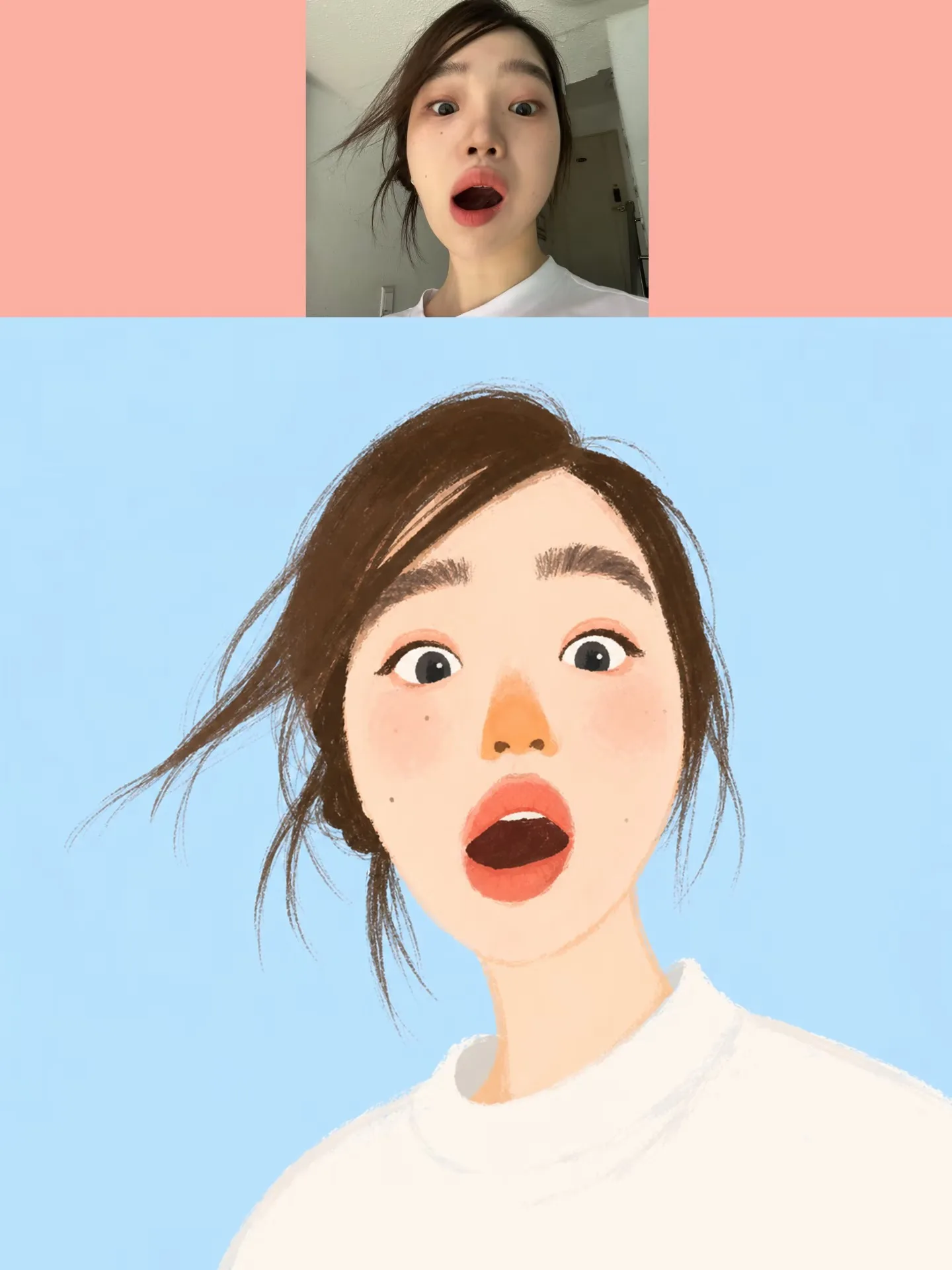
A viral one from the Chinese side of X. 苏乐 (@ai_suxiaole) posted what she calls the "ugly photo prompt" — "再也不怕丑照片了", never be afraid of ugly photos again — with two before/after pairs. Top halves: genuinely unflattering photos. A woman with messy hair and a full-mouth-open caught-mid-yawn face. A kid in a yellow duck-shaped hat, eyes darting sideways, mouth agape. Bottom halves: the exact same faces, same expressions, same messy hair strands — repainted as warm, charming hand-painted pastel illustrations on a flat powder-blue background. Not beautified. Not slimmed. The double chin and the panic stay; they just look like they were painted by a stylish editorial illustrator.
The tweet pulled 1,686 likes and 1,461 bookmarks — the bookmark-to-like ratio tells you people are saving this one to use.
The prompt itself lives in the author's self-reply, and it's long and unusually rigorous. The first third is pure identity preservation: keep the face shape, head angle, gaze direction, expression, mouth state, hairstyle including loose strands, pose, shoulder orientation, visible clothing type, even moles and freckles. Three explicit prohibitions: don't replace the person with a generic attractive character, don't change age or ethnicity, don't beautify the face into a different person. That's the whole trick of why it works — it's an anti-beautification filter as much as a style transfer.
Then the style sections read like a painter's spec sheet: digital gouache, dry pastel, soft colored pencil, chalky brushwork, "clearly illustrated rather than photographic". Eyes get slightly enlarged with one or two tiny painted highlights — but "NOT anime-like, no giant anime eyes". The nose is simplified into a soft warm peach-orange shape, lips become matte coral-red painted shapes, and if the mouth is open, the interior becomes a deep warm burgundy-brown. Hair must stay chocolate/espresso brown rather than black, with flyaways as scratchy handmade lines. Background: uninterrupted powder-blue, no furniture, no text, no digitally generated gradients. And a huge AVOID list closing with the three that matter most: beautification, face reshaping, generic doll-like faces.
Here is the full prompt, verbatim (posted in English by the author):
Transform the uploaded photograph into a hand-painted pastel portrait illustration while using the uploaded image as the primary reference for the person, pose, expression, hairstyle and recognizable identity.

IMPORTANT:
This is a STYLE TRANSFORMATION of the uploaded photograph.

Preserve the recognizable subject from the source image:
- identity and distinguishing facial characteristics
- general face shape and facial relationships
- head angle
- gaze direction
- facial expression
- mouth state and expression
- hairstyle
- hair direction and important loose strands
- pose
- shoulder orientation
- visible clothing type
- important personal facial marks such as moles or freckles when visible

Do not replace the person with a generic attractive character.
Do not substantially change age, ethnicity, gender presentation, hairstyle or expression.
Do not beautify or reconstruct the face into a different person.

STYLE:

Render the portrait as a charming contemporary hand-painted editorial illustration using a mixture of digital gouache, dry pastel, soft colored pencil and slightly chalky brushwork.

The result should clearly look illustrated rather than photographic.

Use:
- matte painted surfaces
- visible dry-brush grain
- slightly rough handmade edges
- irregular brush strokes
- subtle pigment variation
- sparse pencil-like detail
- imperfect organic linework
- gentle asymmetry
- simplified graphic shapes

The drawing should feel warm, spontaneous, soft and handmade.

Avoid perfectly smooth digital rendering.

FACIAL INTERPRETATION:

Translate the real face into a simplified expressive painted portrait.

Preserve the person's identity, expression and characteristic facial relationships, but simplify small anatomical and photographic details.

Use mild expressive caricature only:
- make the eyes slightly larger and clearer than in the photograph
- retain the original eye direction and expression
- gently simplify and soften the face contour
- preserve recognizable spacing between eyes, nose and mouth
- preserve characteristic facial marks
- do not radically change facial proportions

The result should remain recognizably the same person.

EYES:

Render the eyes as simple expressive hand-painted shapes.

Use:
- slightly enlarged rounded eyes
- warm off-white sclera
- very dark brown or near-black pupils
- one or two tiny natural painted highlights
- irregular dark upper lash lines
- softly painted eyelashes
- minimal iris detail
- subtle peach or coral eyelid accents

Keep the eyes lively and expressive but NOT anime-like.

Do not create giant anime eyes.
Do not create perfectly symmetrical vector eyes.
Do not render photorealistic irises.

EYEBROWS:

Simplify the eyebrows into thick, textured dark-brown brush strokes.

Retain their original position and general shape.

Allow individual rough strokes and uneven pigment rather than clean graphic curves.

NOSE:

Simplify the nose strongly.

Represent it mainly with a soft warm peach-orange painted shape rather than realistic anatomical modeling.

Keep the bridge subtle.

Use very little contouring.

Represent the nostrils with minimal small dark-brown painted marks.

Avoid a realistic sculpted or heavily shaded nose.

MOUTH:

Preserve the exact emotional character and open/closed state of the mouth from the source photograph.

Render the lips as simplified matte coral-red or salmon-red painted shapes.

If the mouth is open:
- simplify the mouth interior into a deep warm burgundy-brown shape
- show teeth only when naturally visible
- reduce unnecessary anatomical detail
- retain the original expression

Use slightly irregular painted edges rather than clean vector outlines.

SKIN:

Convert photographic skin into smooth, luminous, matte painted skin.

Use a warm light ivory-peach / pale apricot base.

Remove:
- pores
- photographic microtexture
- shine
- harsh realistic shadows
- fine skin noise

Retain enough facial shape to preserve identity.

Add only restrained painterly color variation:
- soft salmon-pink blush on the cheeks
- subtle warm peach around the nose
- faint peach-pink around the eyelids
- gentle warm shading below the jaw or around the neck when necessary

Keep shading broad, soft and minimal.

Do not use glossy skin.
Do not use realistic skin texture.
Do not create plastic 3D skin.
Do not make the face completely flat like vector art.

HAIR:

Preserve the hairstyle, parting, silhouette and important loose strands from the uploaded photograph.

Paint the hair using warm chocolate brown, espresso brown and deep reddish-brown rather than neutral solid black.

Build the main hairstyle from broad opaque painted masses.

Overlay selected areas with rough thin dry-brush and colored-pencil strokes.

Loose strands and flyaway hairs should appear as scratchy, spontaneous handmade lines.

Hair edges should remain slightly irregular and painterly.

Do not render glossy photorealistic hair.
Do not turn the hairstyle into a smooth anime helmet shape.

CLOTHING:

Preserve the recognizable clothing and its basic shape.

Simplify fabric substantially.

For white clothing, use warm ivory and soft off-white rather than sterile digital white.

Represent folds with only a few pale gray-beige or warm shadow brush marks.

Keep clothing lower-detail than the face and hair.

BACKGROUND:

Remove the original photographic environment.

Replace it with a simple uninterrupted pastel powder-blue / pale sky-blue painted background.

Use approximately the visual family of:
soft baby blue,
powder blue,
light cyan-blue.

The background should be mostly flat but may contain extremely subtle natural brush or pigment variation.

Do not include:
- furniture
- architecture
- scenery
- room details
- decorative patterns
- text
- symbols
- gradients that look digitally generated
- photographic depth of field

COMPOSITION:

Prioritize the person.

Create a clean portrait composition similar to an illustrated profile portrait.

Keep the source head angle, expression and body orientation.

A modest portrait-oriented crop or enlargement is allowed when needed to make the head and upper torso the dominant visual subject.

Do not arbitrarily change the pose.

TEXTURE:

The finished image should contain visible but restrained handmade texture.

Especially use:
- dry gouache texture
- chalky pastel grain
- colored-pencil-like hair strokes
- rough brush boundaries
- slight variations in pigment opacity

The texture must feel intentionally handmade but clean.

Do not add heavy paper noise across the entire image.

COLOR PALETTE:

Use a limited soft pastel palette:

background:
powder sky blue

skin:
light ivory peach,
pale apricot

blush:
soft salmon pink

nose:
warm peach-orange

lips:
coral red / salmon red

mouth interior:
deep reddish brown / burgundy brown

hair:
warm chocolate brown / espresso brown

eyes and eyelashes:
very dark warm brown

clothing:
warm ivory / creamy off-white where appropriate

Keep colors bright, matte, warm and harmonious.

RENDERING PRIORITY:

1. recognizable identity
2. original expression
3. original hairstyle and loose hair gesture
4. expressive eyes and mouth
5. simplified facial anatomy
6. characteristic pastel color palette
7. handmade dry-brush texture
8. clean pale-blue background

AVOID:

photorealism,
semi-realistic AI portrait painting,
3D rendering,
Pixar-like rendering,
anime,
manga,
cel shading,
vector illustration,
clean geometric outlines,
comic-book ink outlines,
hyper-detailed skin,
realistic pores,
glossy skin,
realistic hair strands everywhere,
heavy cinematic lighting,
dramatic shadows,
high contrast,
neon colors,
dark background,
complex scenery,
excessive detail,
perfect symmetry,
plastic smooth gradients,
beautification,
face reshaping,
generic doll-like faces.

FINAL RESULT:

A recognizable transformation of the uploaded person into a warm, playful, hand-painted pastel portrait illustration: powder-blue background, luminous peach skin, coral facial accents, chocolate-brown textured hair, simplified expressive facial features, slightly enlarged lively eyes, minimal nose modeling, matte color, rough dry-brush edges and subtle colored-pencil texture.

The final image should feel like an original hand-painted lifestyle/editorial portrait rather than a filter applied to a photograph.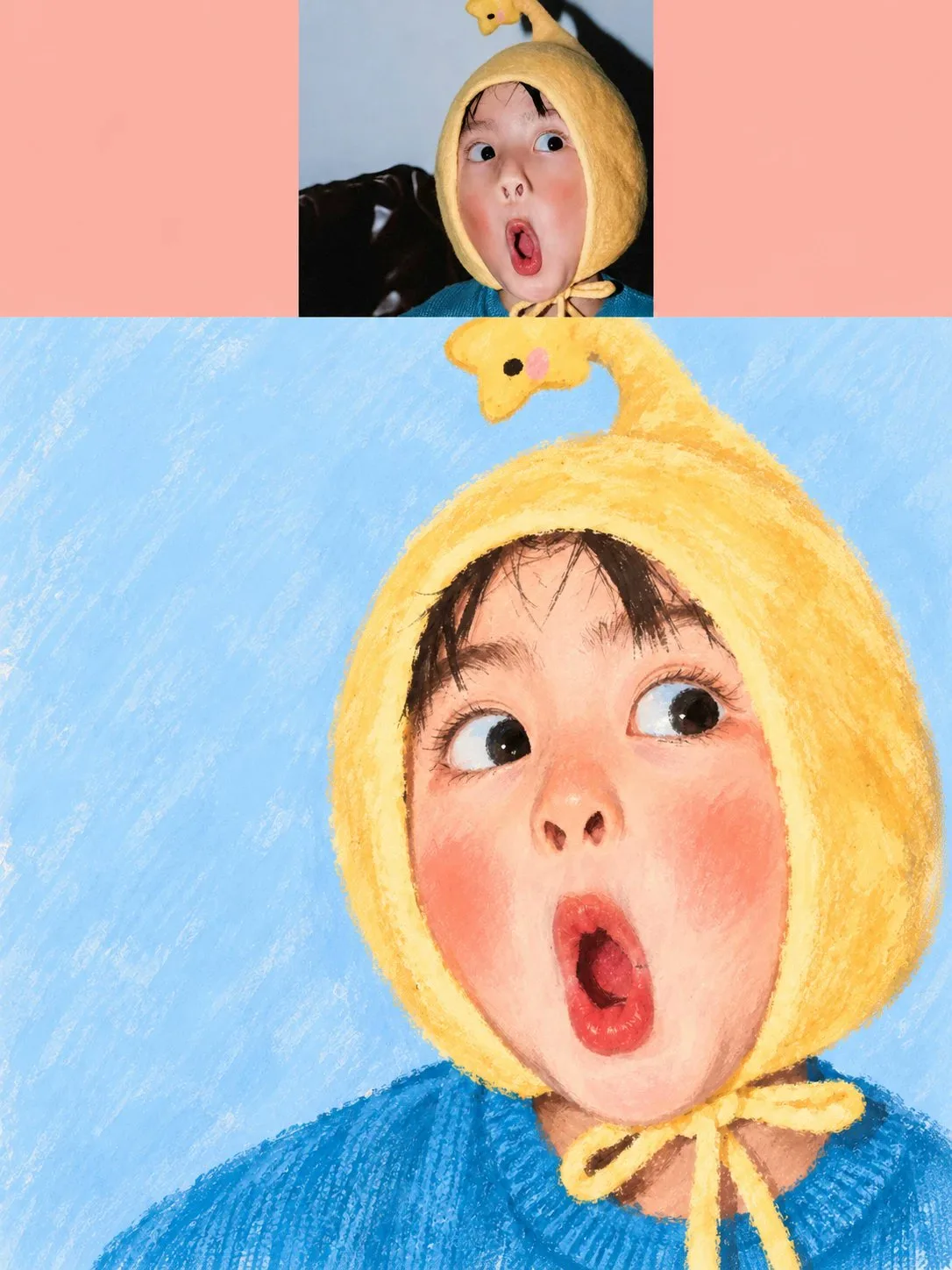
The two samples prove the concept: the woman's mid-yawn panic and every stray hair strand survive the repaint, and the kid in the duck hat keeps the exact side-eye and open mouth — just in chalky crayon texture on baby blue. The expression is the joke, and the prompt knows it: most "make my photo pretty" prompts fail precisely because they sand the expression off, and this one hard-codes "preserve the mouth state" and "do not beautify".
A small note: the prompt was posted in English in the author's self-reply about twenty seconds after the main tweet; the caption on the main tweet is in Chinese. At the time of archiving the main tweet had 1,686 likes, 156 retweets, 1,461 bookmarks, 212,487 views and 32 replies; the prompt reply had 178 likes, 25 retweets, 296 bookmarks and 10,362 views.
Original tweet: 苏乐 on X · Prompt: the self-reply