PROMPT · Image Editing
Sparse Crayon Travel Gesture Photo-to-Diptych Prompt
A free photo-to-poster prompt that splits any picture into a vertical diptych: the untouched photo on top, and below it an extremely reduced hesitant-crayon line study on warm white paper, with at least 55% negative space and a short handwritten observation.
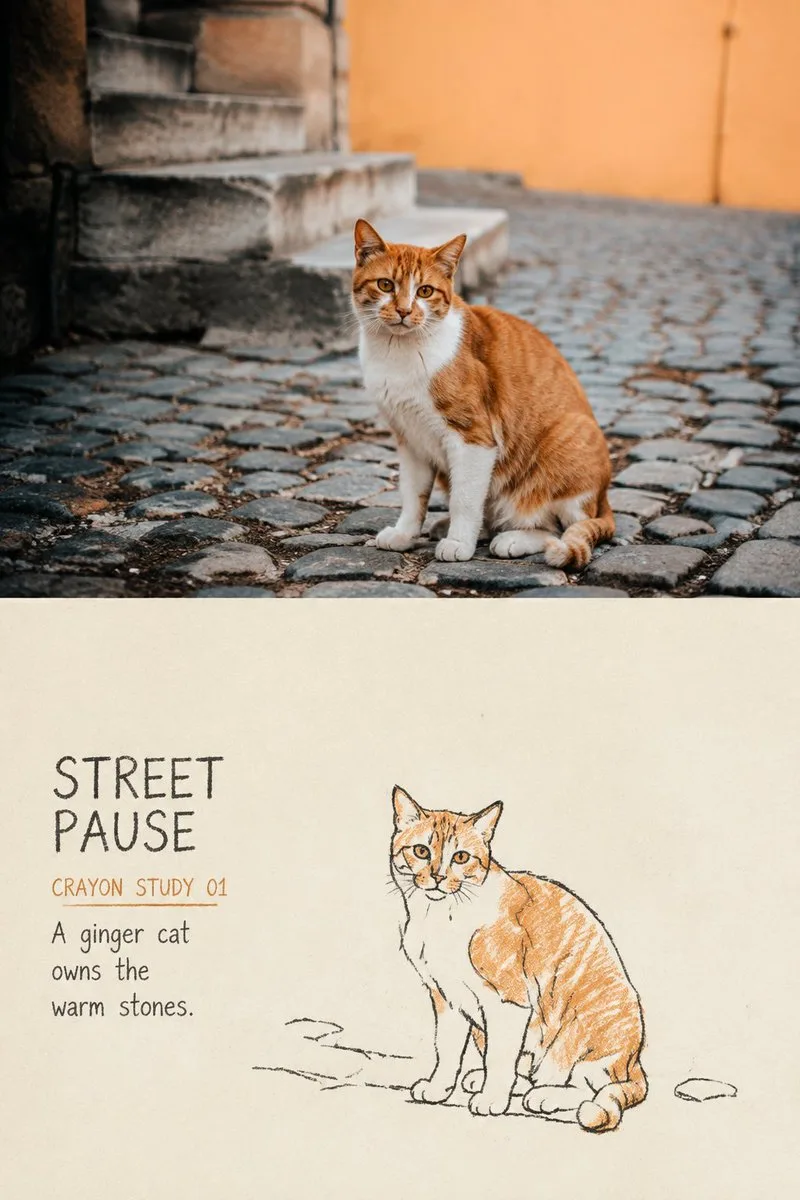
Scrolled past a quietly lovely one. 蛋黄堡 (@Hamburgerai) shared a photo-to-poster prompt called SPARSE CRAYON TRAVEL GESTURE — a style that takes any photo and rebuilds it as a vertical before/after diptych: the untouched photo on top, and below it almost nothing. A cat, a stack of suitcases, a camera on a café table, a bicycle against a wall — each reduced to a few hesitant, broken crayon lines and a smear of color, with the warm white of the paper doing most of the drawing. The author's own framing: leave a few doubting lines and a little color, and ordinary objects look like they were jotted down in passing before a trip — and somehow stick in memory better than a full rendering would.
The prompt handles two kinds of subjects. For an animal, you keep only the essentials: ear shape, head-to-body proportion, tail direction, standing or sitting posture, expression. For a travel object, you keep only what defines its identity: outline, handles, wheels, lens, rim, folds, straps, wear marks. Nearly the whole background gets deleted — a short ground line, a wall corner, a stone, or one or two light clues about where the thing was used.
The numbers in it are what make it work as a system rather than a vibe: the subject occupies 38–58% of the drawing area's width and 30–52% of its height, placed low-center or slightly off to one side, and continuous warm-white negative space must be at least 55%. Lines are allowed to cross their own boundaries, paper edges can look torn, fills stay unfilled, strokes repeat and stop mid-line. And no filling the subject in — the paper white literally forms the animal's body and the object's surface. A short English title, a "CRAYON STUDY 01"-style field, and one observation line written from facts in the photo go into a quiet patch of white, in the same wobbling crayon handwriting, clearly readable.
Here is the full prompt, translated from the original Chinese:
Please turn each photo I upload into a separate
"SPARSE CRAYON TRAVEL GESTURE" original-photo comparison poster — one poster per photo, no multi-image collages.

This style works both for a single animal with clear silhouette and posture, and for travel objects with a clear single-body outline: suitcase, camera, hat, shoes, coffee cup, pottery, bicycle, roadside seat, or a small souvenir.

Use a vertical two-panel structure overall, top and bottom each taking about 50%, with a clean, straight boundary between them.

The top half faithfully keeps the original photo. Accurately preserve the animal's or travel object's identity, count, posture, orientation, outer contour, key structures, light and shadow, and real environment; apply only light photographic color grading. Do not change the subject or turn the photo area into an illustration.

The bottom half uses extreme reduction and distillation.

If the subject is an animal, keep only the most important ear shapes, head-to-body proportion, tail direction, standing or sitting posture, and expression.

If the subject is a travel object, keep only the outer contour, handles, wheels, lens, rim, folds, straps or wear marks that define its identity.

Delete almost the entire background; keep only a short ground line, a wall corner, a stone, or one or two light clues that explain where it was used.

Use hesitant, broken, slightly pausing black crayon outlines, plus one or two pale crayon scumbles extracted from the original photo. Allow lines crossing their boundaries, torn paper edges, unfilled areas, repeated strokes, and the pencil stopping partway.

Do not fill the subject in completely. Let the paper white directly form the animal's body, the object's surface, and the surrounding space. Travel objects must not be drawn as refined product illustration or accurate industrial drafting.

The subject occupies about 38%–58% of the drawing area's width and 30%–52% of its height, usually placed in the lower-middle or slightly toward one side. Continuous warm-white paper negative space must be no less than 55%.

In a quiet area of paper white, add a short English title, a "CRAYON STUDY 01"-style field, and one observation line drawn from facts in the photo. The text uses the same slightly wobbling crayon handwriting as the image and must be clearly readable.

Avoid fine fur detail, cute vector mascots, complete coloring, dense doodling, full backgrounds, smooth digital pencil, refined product illustration, text that is too small, artist signatures, logos and watermarks.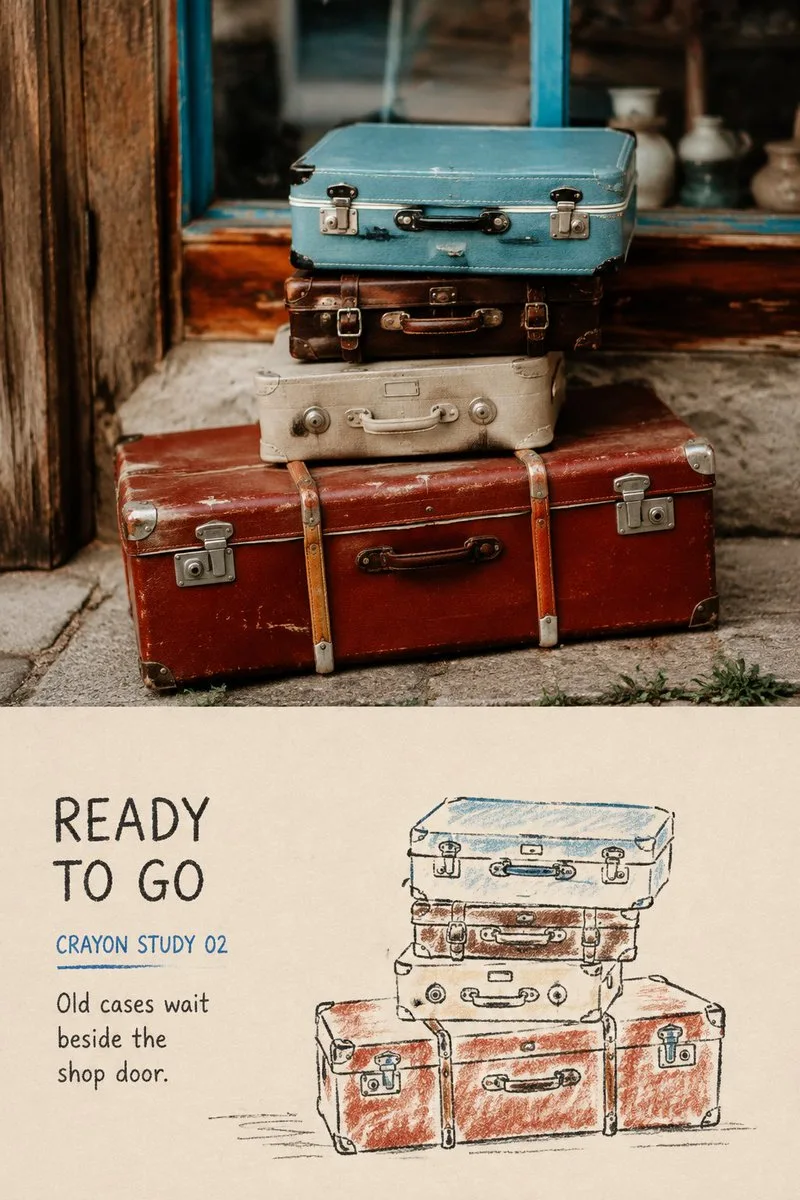
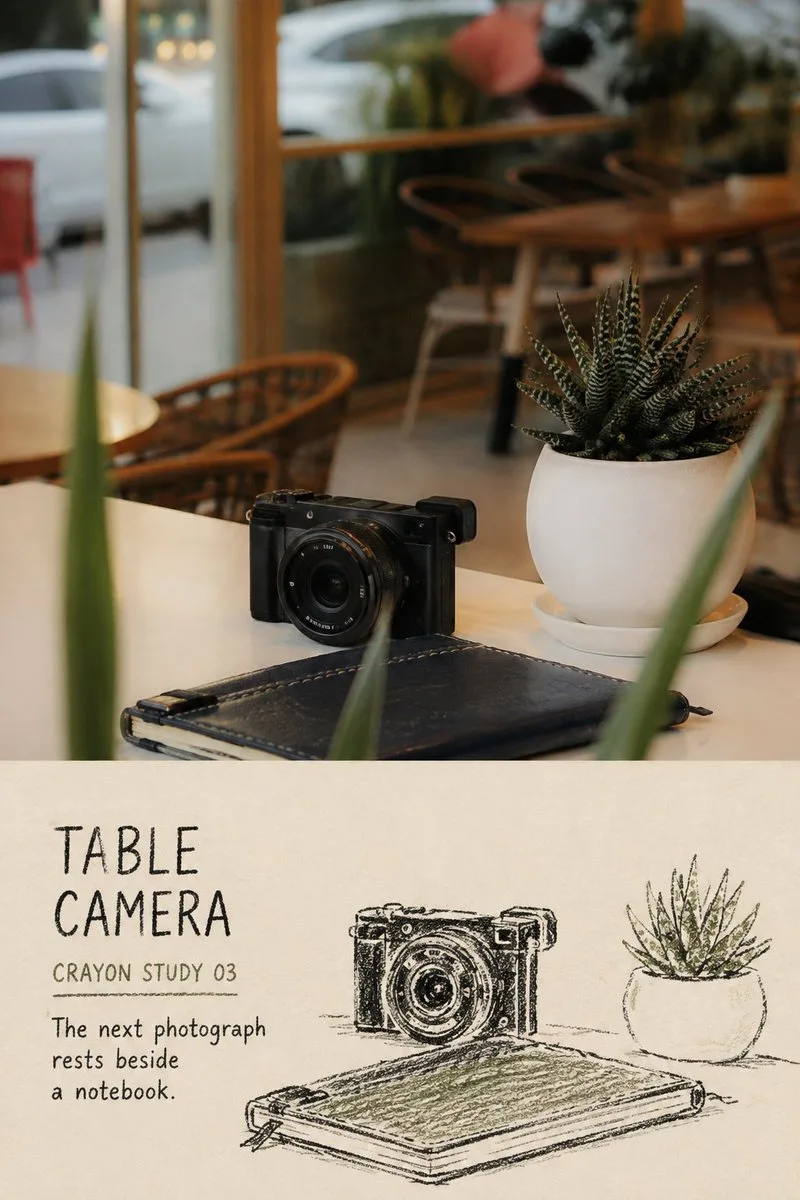
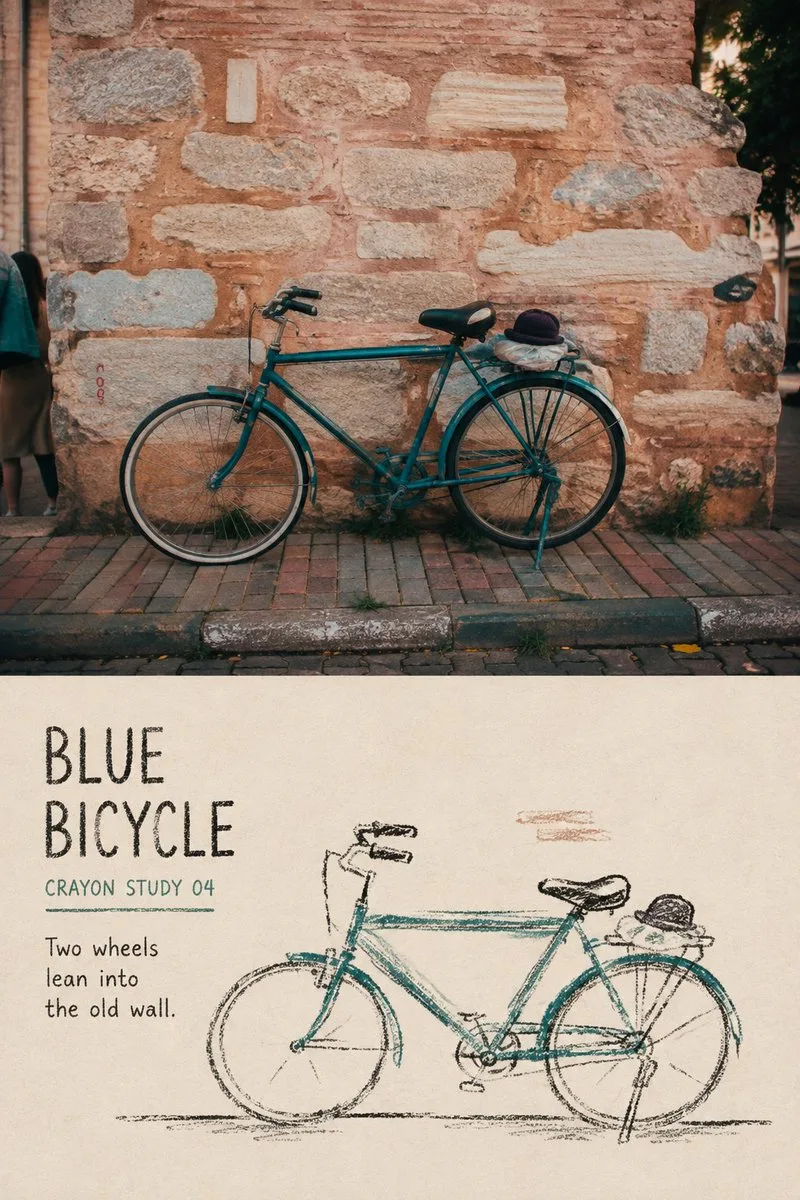
The four samples run the deck: a ginger cat on cobblestones becomes "STREET PAUSE — a ginger cat owns the warm stones"; a stack of vintage suitcases outside a shop becomes "READY TO GO"; a mirrorless camera beside a succulent and a notebook becomes "TABLE CAMERA"; and a teal bicycle propped on an old stone wall becomes "BLUE BICYCLE". Each bottom panel keeps exactly one or two crayon colors pulled from the photo — the cat's orange, the cases' red and blue, the bike's teal — and the handwritten observation lines do a quiet job of narrating the trip.
At the time of archiving the tweet had 99 likes, 14 retweets, 72 bookmarks, 3,217 views and 42 replies.
Original tweet: 蛋黄堡 on X